

How I Used AI to Find the Hidden Behaviors That Predict Which Readers Will Buy
The simple metric that tells you who will purchase—before they do


Before last month, I tracked opens and engagement for my posts.
That was a mistake.
After pulling 69,522 Substack events and 1,244 Gumroad transactions into an analytics database and running it through AI, one clear signal stood out: 88.9% of purchasers clicked at least one link before buying — compared with 15.6% of non-purchasers.
In plain English: link clicks are 4.5× more predictive of future purchases than opens, comments, or total engagement.
I was surprised and a little embarrassed.
That’s what pushed me to trace every purchase back through my content, timelines, and clicks.
What I found changed how I publish, what I optimize for, and how I think about revenue from this newsletter.
Part 1: The Methodology — How I Analyzed My Data
Creators talk a lot about engagement but rarely about behavior.
I wanted to know what my readers actually do before they spend money.
So I tracked everything.
I fed all my Substack and Gumroad data into a single analytics database so AI could analyze every behavior leading up to a purchase.
What I Tracked
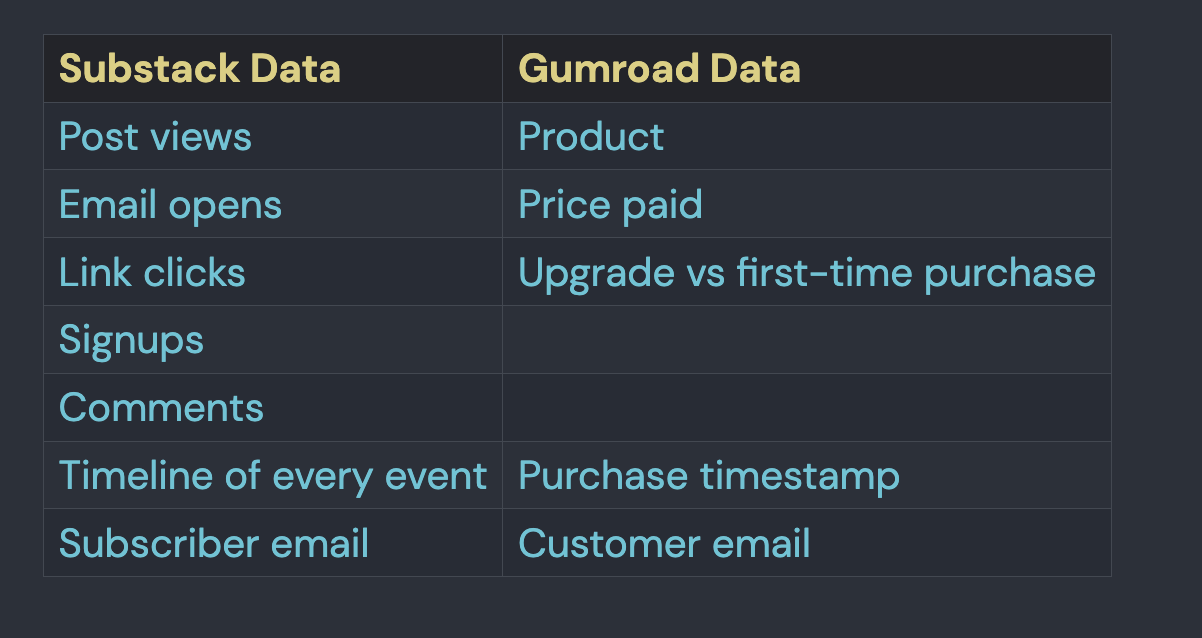
Here is a shortened list of data I used for this analysis.
I used the Cursor app connected to a DuckDB SQL database using an MCP server.
Connecting the Two Data Sources
I then matched email addresses across Substack and Gumroad. This gave me a unified behavioral timeline for both purchasers and non-purchasers.
Note that many people use different email addresses for their Substack and Gumroad accounts, so this method has some limitations.
Most people analyze sales in isolation.
I wanted to understand the pathway to the sale.
The Substack backend tracks each step, but manually extracting subscriber events is cumbersome. This is one of the reasons why I’m building the StackContacts CRM tool.
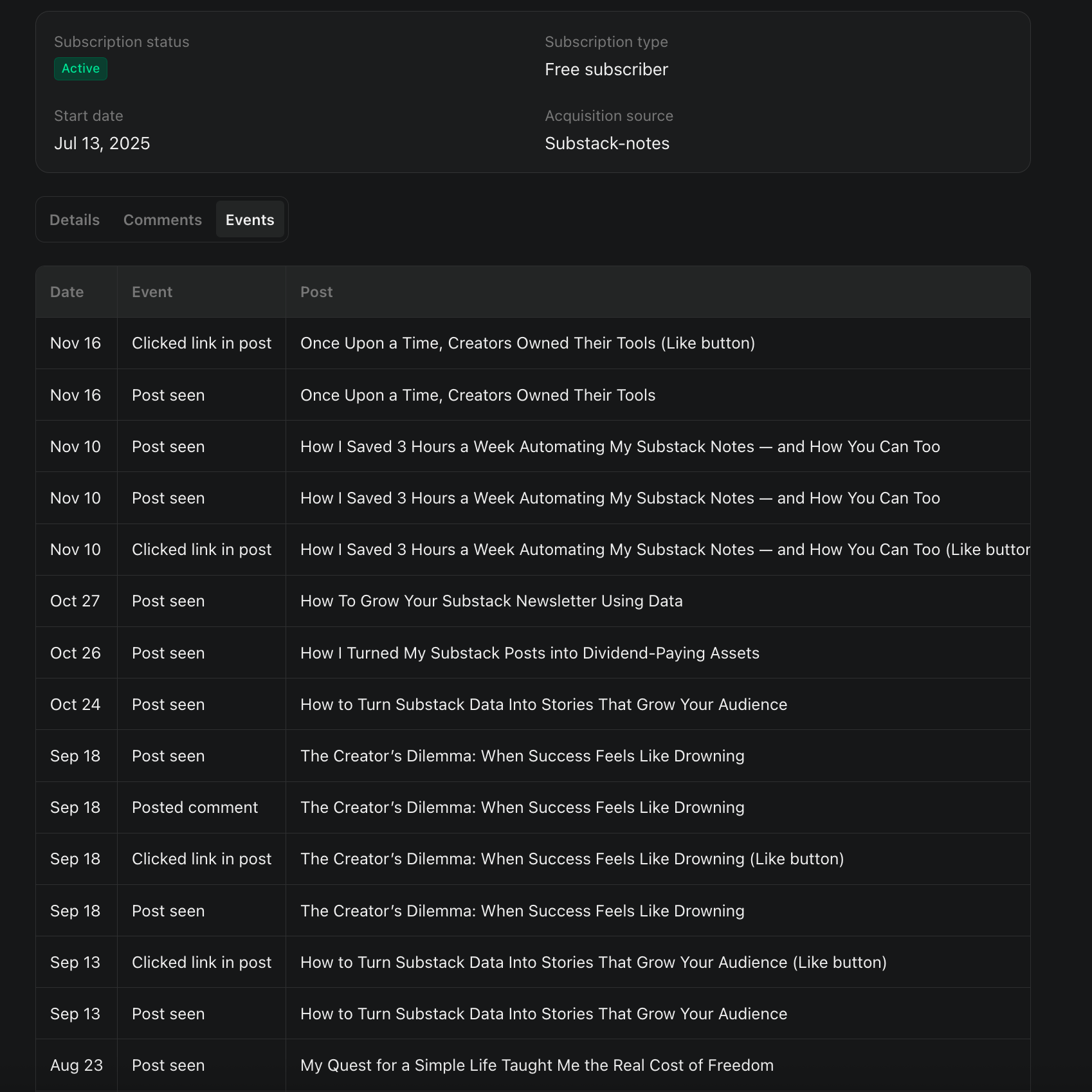
For data nerds only: All these 69,522 events have timestamps and details that AI can use to map relationships across 563 separate database tables. The total size of this database is 302.5 Mbytes.
This story explains the why and how I built the tool I’m using:

The AI Analysis Process
I asked AI to analyze my posts, subscriber behavior patterns based on events, and Gumroad product sales transactions.
The AI created SQL queries and pulled three sets of data:
90 purchasers with complete behavioral histories
876 non-purchasers with high-engagement histories
The entire event sequence of each group
I cannot emphasize the importance of item #3 enough.
Substack backend collects a lot of data on subscribers’ activities. All these events, and even the clicked links' URLs, are available on the web pages, but it is just complicated for AI to access them for a large group of subscribers.
My StackContacts tool transforms this data into an accessible analytics database.
AI then analyzed:
Time between events
Order of events
Repeated patterns
Link-click behavior
Post-level conversion
Product-specific pathways
Surfacing Purchaser Behavior Patterns
AI quickly surfaced and summarized the patterns that humans would miss:
Purchasers behave differently long before they purchase
There are unique timing patterns
Some posts predict purchases
Link clicks form a semi-consistent sequence before revenue
I learned more about my audience in 2 hours than in 2 years of guessing.
Why This Matters
Most creators optimize for the wrong things:
Email opens
Total views
Comment count and likes
But these tell you nothing about revenue.
This data flipped my assumptions:
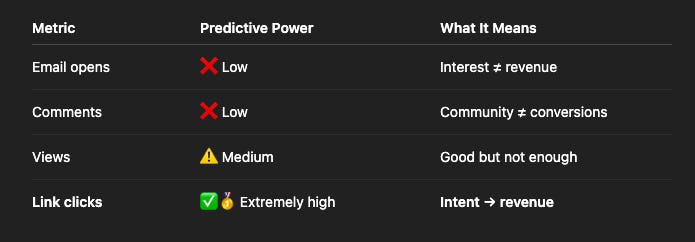
Email opens are NOT predictive of purchases.
Link clicks ARE.
Creators guess what works.
Data reveals what actually works.
Small changes — like moving a CTA link higher in a post — can produce disproportionately large revenue increases.
Part 2: The Three Buyer Personas I Discovered
After analyzing hundreds of thousands of data points, AI surfaced three buyer personas with distinct patterns.
Here’s what surprised me most:
These personas aren’t abstract “marketing avatars.”
They are behavioral profiles derived from actual actions prior the purchase.
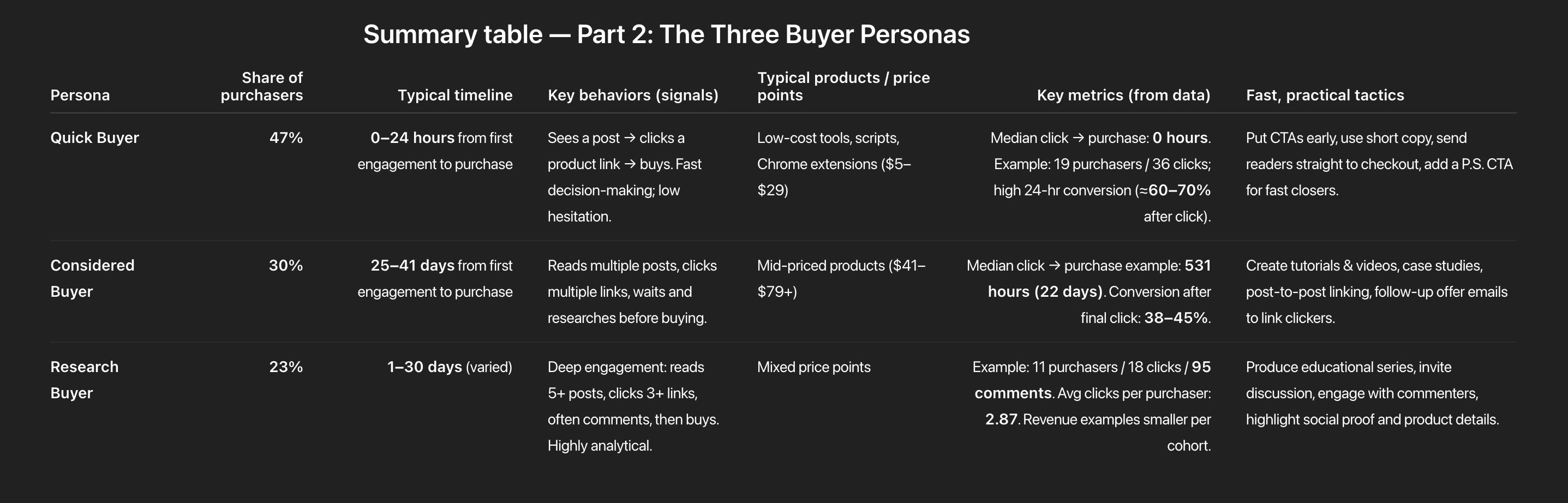
Let’s review the details.
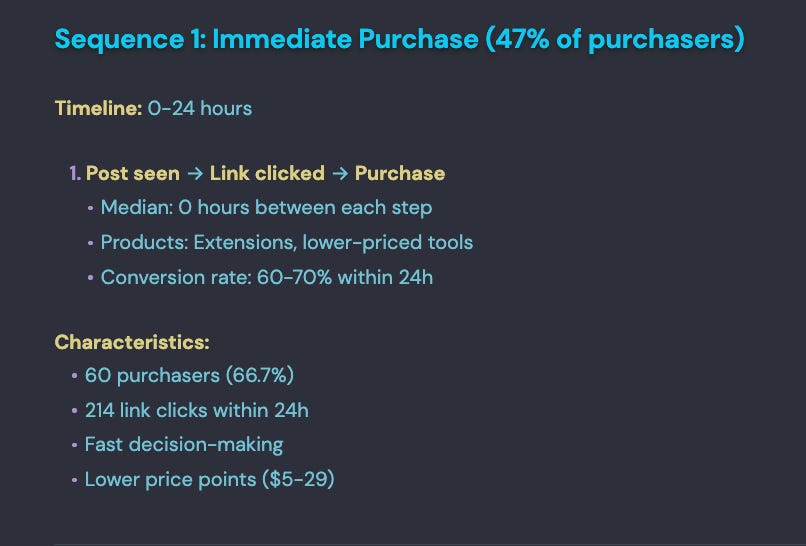
Persona 1: The Quick Buyer (47% of purchasers)
The Quick Buyer moves fast — much faster than I imagined.
Characteristics
Timeline: 0–24 hours from first engagement to purchase
Behavior:
Post seen
Link clicked
Purchase
Median time between click and purchase: 0 hours
Products: low-cost $5–$29 tools, scripts, Chrome extensions
Conversion rate: 60–70% within 24 hours of a link click
This is the reader who sees something they want and buys it immediately.
Real Example

19 purchasers from the above post
36 link clicks
Median time from click → purchase: 0 hours
$475+ revenue (of $10,819.30 total)
The moment they see the product, they decide.
What This Means
These buyers are already problem-aware
They will buy NOW if you make it easy
Shorter copy and clearer CTAs boost conversions
Sending them directly to the checkout page works
Urgency helps — not fake urgency, but clarity:
“Join 500+ creators”
“Limited-time upgrade”
“Available today”
Actionable Takeaways
Put your CTA early in the post (I added a product link)
Make the checkout two clicks or less
Don’t bury the core value
Add a P.S. CTA for fast movers
Now I finally understand why
has these CTAs at the end of every email he sends to his 175,000 subscribers. It just works for this Quick Buyer persona.
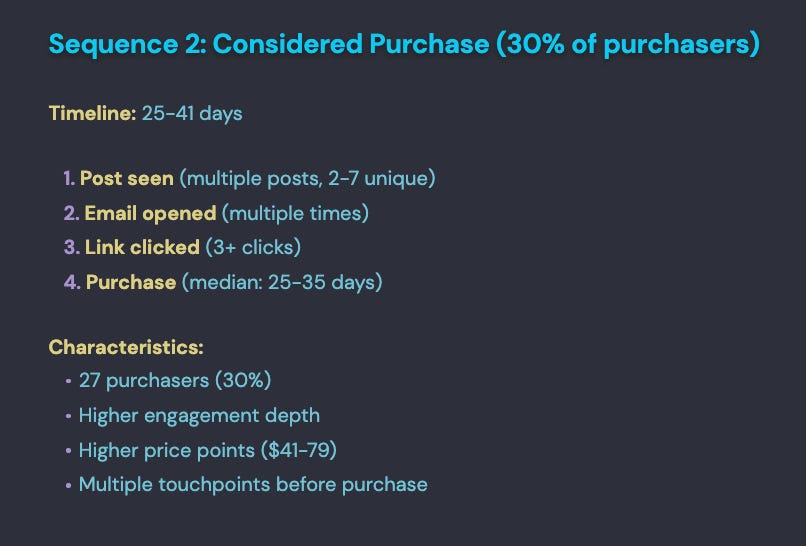
Persona 2: The Considered Buyer (30% of purchasers)
This group moves slower — but more intentionally.
Characteristics
Timeline: 25–41 days from first engagement to purchase
Behavior:
Reads multiple posts
Clicks multiple links
Waits
Buys
Price points: $41–$79+
Conversion rate: 38–45% within 24 hours of final click
These buyers need proof.
Real Example

18 purchasers
22 link clicks
Median time from click → purchase: 531 hours (22 days)
$1,020+ revenue ( of $4,045.25 total)
This audience researches.
They compare.
They return later — when the timing is right.
What This Means
Higher-priced products require multiple touchpoints
They need reassurance
They want to see how the product works
Long-form guides help convert them
These are your most thoughtful customers.
Actionable Takeaways
Create tutorials & videos
Add case studies
Use post-to-post linking
Send follow-up offer emails to link clickers
Add detailed product guides
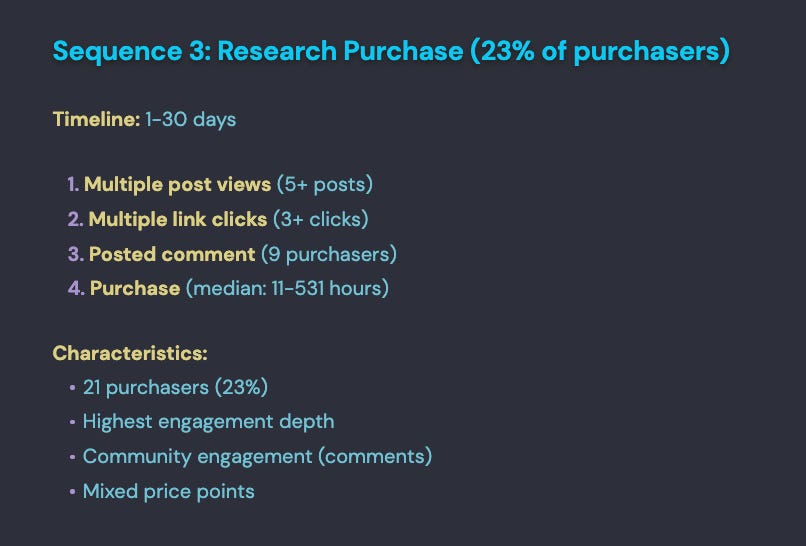
Persona 3: The Research Buyer (23% of purchasers)
This is the “deep engagement” persona — the one who consumes everything before buying.
Characteristics
Timeline: 1–30 days
Behavior:
Reads 5+ posts
Clicks 3+ links
Often comments
Buys after intense engagement
Products: Mixed price points
Highly analytical
These readers don’t impulse buy.
They want to understand the creator and the product.
Real Example:

11 purchasers
18 link clicks
95 comments
Avg link clicks per purchaser: 2.87
$275+ revenue
Their comments are thoughtful.
They’re already halfway sold — they need confirmation.
What This Means
These buyers respond to education
They want community and conversation
Comments signal their readiness
These are the readers who follow your work closely.
Actionable Takeaways
Create an educational content series
Invite discussion at the end of posts
Engage with commenters, answer questions
Show your expertise (not your hype)
Part 3: The Surprising Findings That Changed My Strategy
As I dug deeper into the data, four findings fundamentally changed how I publish — and what I optimize for.
Here are the details.
Finding #1: Email Opens Do Not Predict Purchases
This one shocked me.
The Data
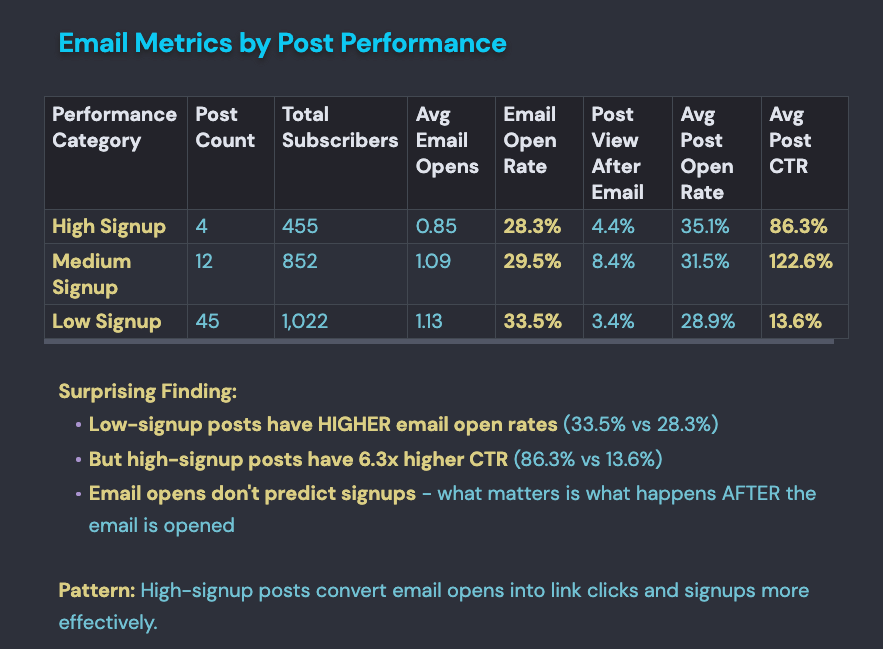
Low-signup posts have higher open rates (33.5% vs 28.3%)
But high-signup posts have 6.3× higher click-through
Email opens = interest
Link clicks = intent
I had always assumed high open rates = good performance.
Wrong.
What I Learned
Don’t optimize for opens
Optimize for what happens after the open
Subject lines should drive action, not vanity
Actionable Takeaway
Track link clicks per email
Not open rates
Write subject lines designed for the click
Finding #2: Link Clicks Are Everything
This is the single most significant predictor of revenue.
The Data
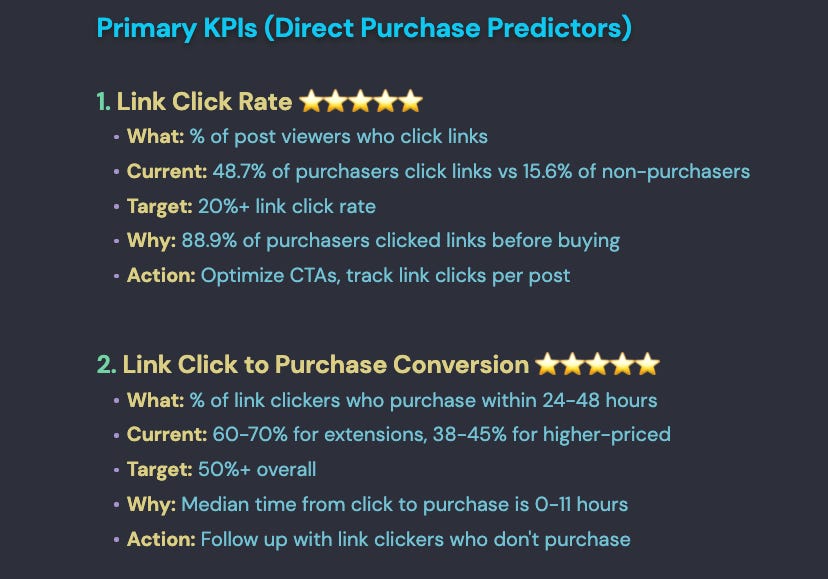
88.9% of purchasers clicked links
Purchasers click 4.5× more links (2.65 vs 0.59)
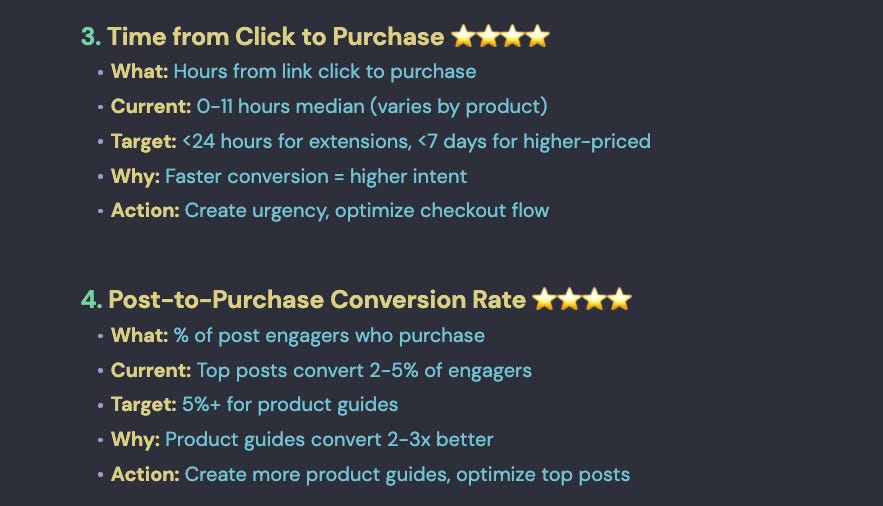
Median time from click → purchase: 0–11 hours
What I Learned
It’s almost impossible to overstate this:
If a reader clicks your link, they are signaling purchase intent — even if they don’t buy that day.
Clicks reveal curiosity.
Clicks reveal readiness.
Clicks reveal the future.
Actionable Takeaways
Use link clicks your #1 KPI (Key Performance Indicator)
Put CTAs early and clearly
Track click → purchase conversion
Tag readers who click links
Finding #3: Product Guides Convert 3× Better
This one wasn’t intuitive until I saw the numbers.
The Data
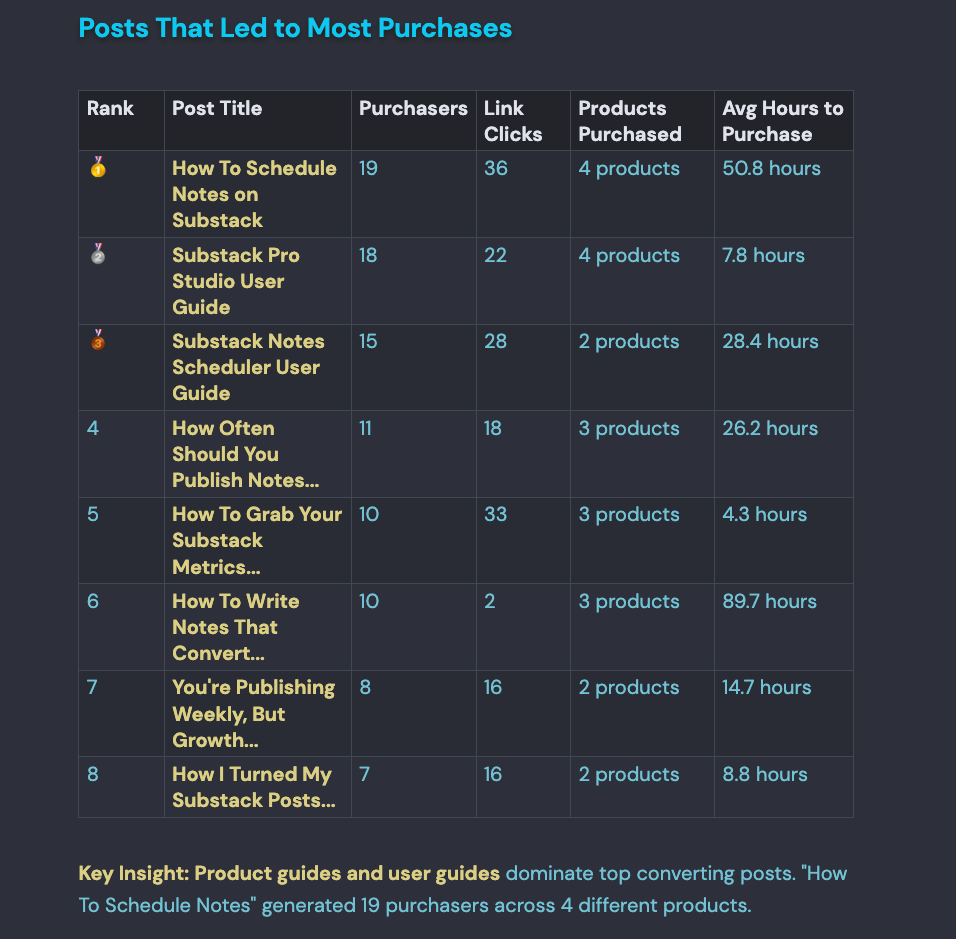
All top 3 converting posts = product/user guides
“How To Schedule Notes” → 19 purchasers
“Substack Pro Studio Guide” → 18 purchasers
Conversion: 2–5% of engagers vs 0.5–1% for other posts
People buy what they understand.
Guides show the tool in action — and people buy confidence.
What I Learned
One year ago, I believed I needed to create the product first, get a few beta testers, build a Gumroad product page, and then start writing user guides and customer-facing materials before the launch.
Wrong.
After seeing this data, I changed my approach. I started writing about the StackContacts CRM tool way before it was ready for prime time, with a focus on results and outcomes.
This article is an example - I’m sharing these results before the product is ready.
Actionable Takeaways
Show results and outcomes, not features
Write a guide for each product
Include real screenshots
Add link clicks throughout the post
Finding #4: Comments Signal Quality, Not Revenue
This was a surprise.
The Data
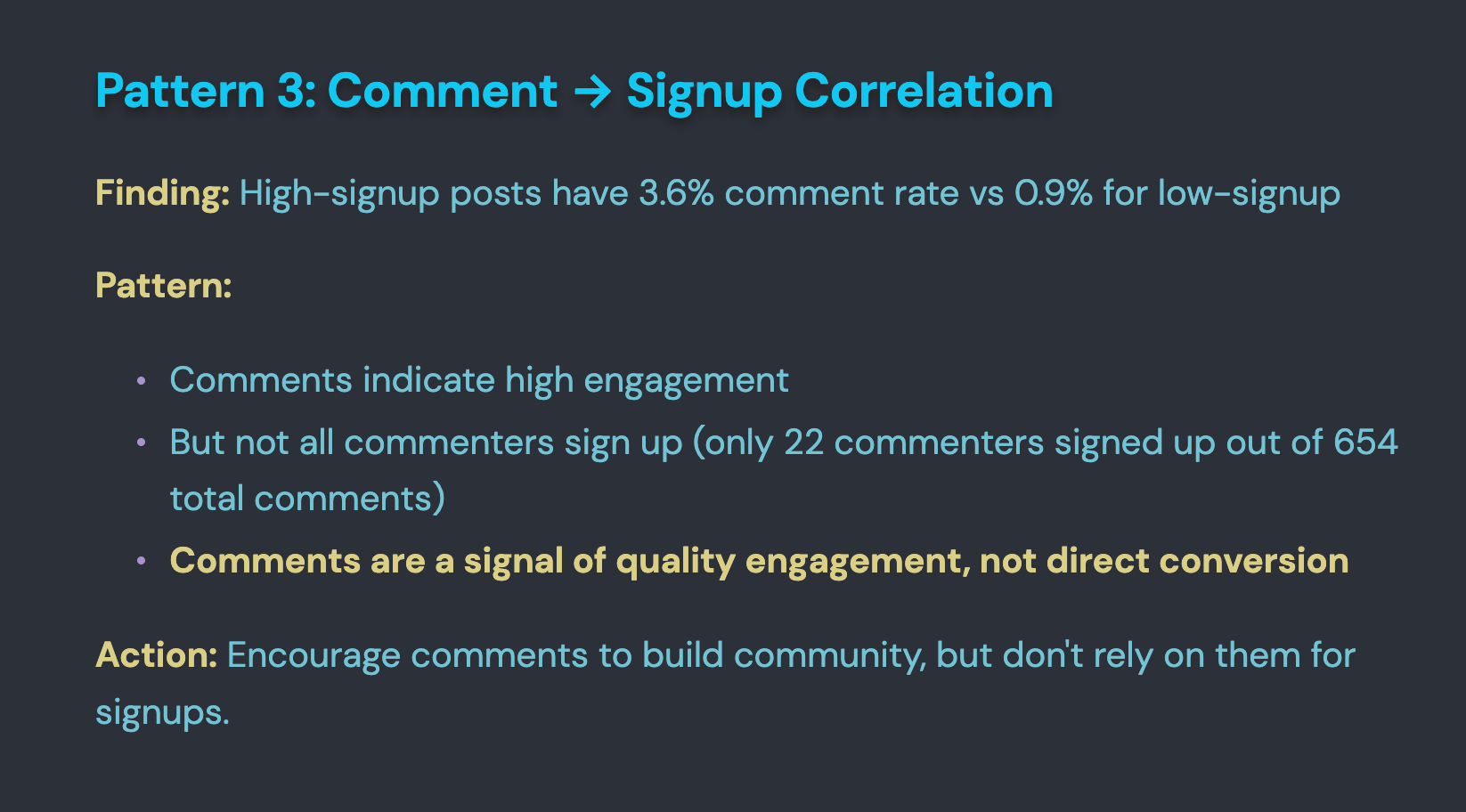
High-signup posts: 3.6% comment rate
Low-signup posts: 0.9% comment rate
But only 22 purchasers came from 654 commenters
Comments = community
Clicks = revenue
It’s easy to misinterpret this.
Comments feel good — they just don’t correlate with product sales.
If you are selling access to the community, it might be a different story for you.
Actionable Takeaways
Encourage comments for the community
But track link clicks for revenue
Don’t let comments mislead you
Do you agree or disagree? Leave a comment
Part 4: The Metrics That Actually Matter
I came away with a short list of metrics that predict product revenue—and those that don’t.
Note that these KPIs are relevant to my business model:
my Substack newsletter is free,
and I sell tools and products on Gumroad.
Your business model may be totally different, so the metrics that matter for you might be different as well. This discovery process will identify these buying patterns from the data and determine which metrics are most predictive of revenue in your case.
Primary KPIs (Most Predictive)
1. Link Click Rate
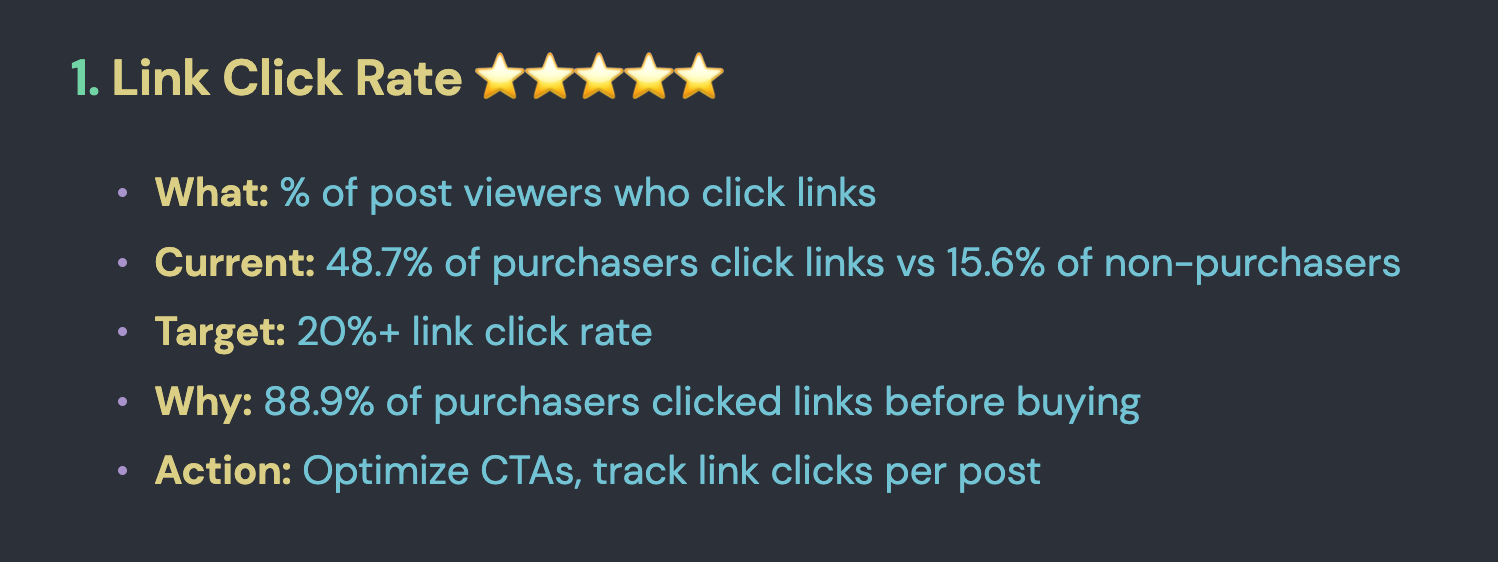
Purchasers: 48.7% click rate
Non-purchasers: 15.6%
Target: 20%+
This is the #1 metric to track.
2. Click → Purchase Conversion
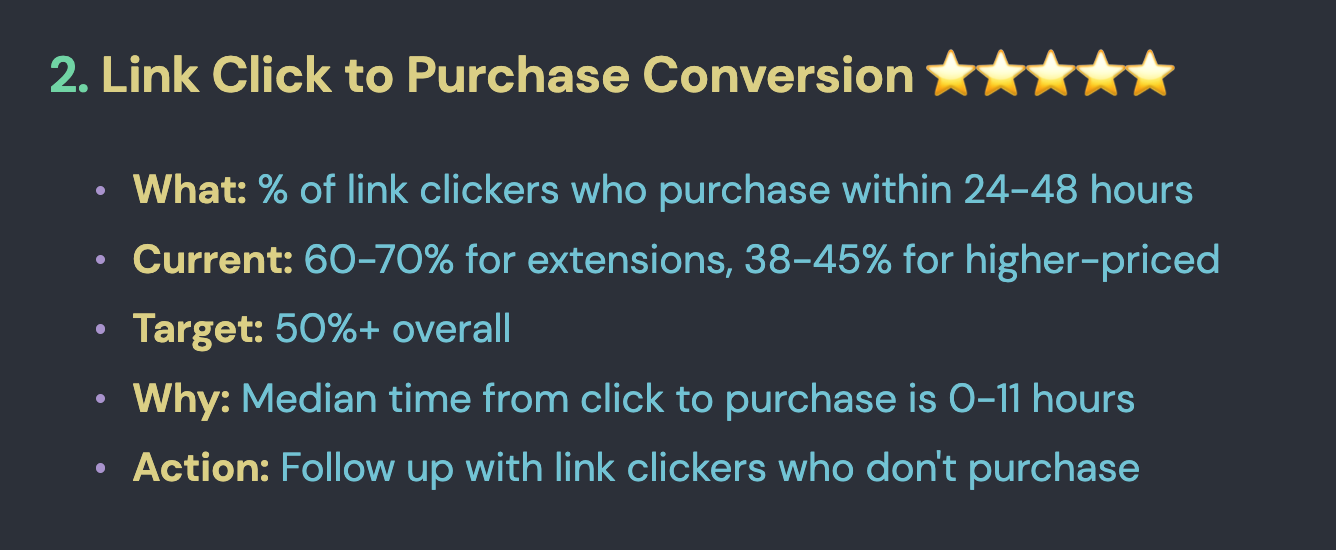
Lower-priced Chrome extensions: 60–70%
Higher-priced products: 38–45%
Target: 50%+ overall
If this is low, fix your product pages.
3. Time From Click to Purchase
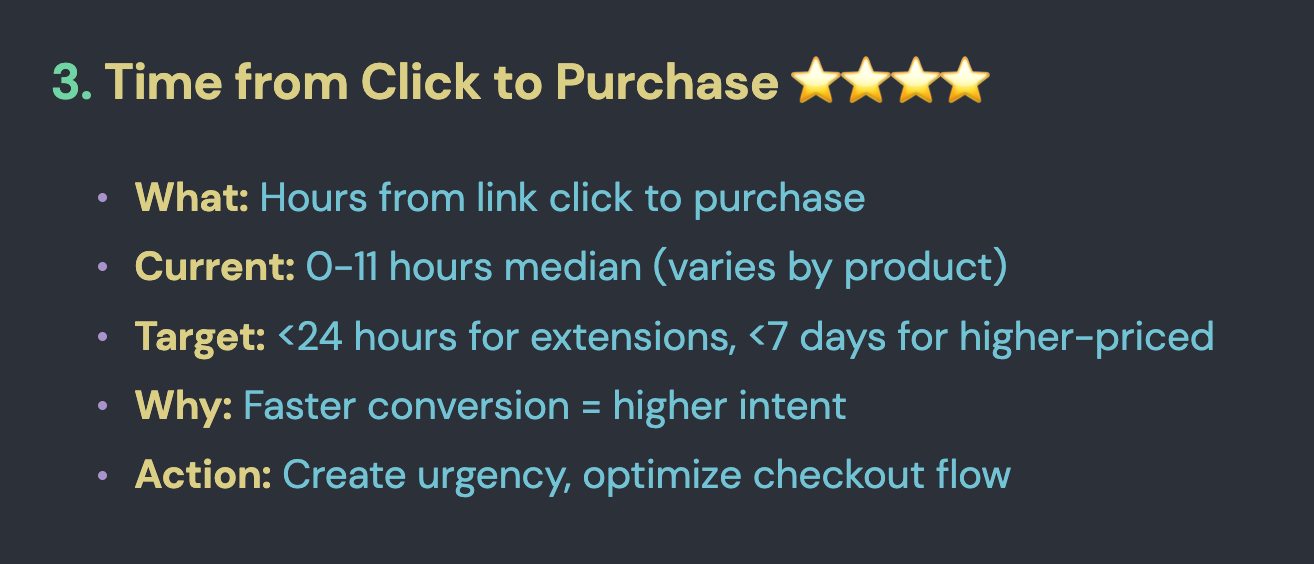
Median: 0–11 hours
Goal: <24 hours for lower-priced tools
The shorter the gap, the stronger the intent.
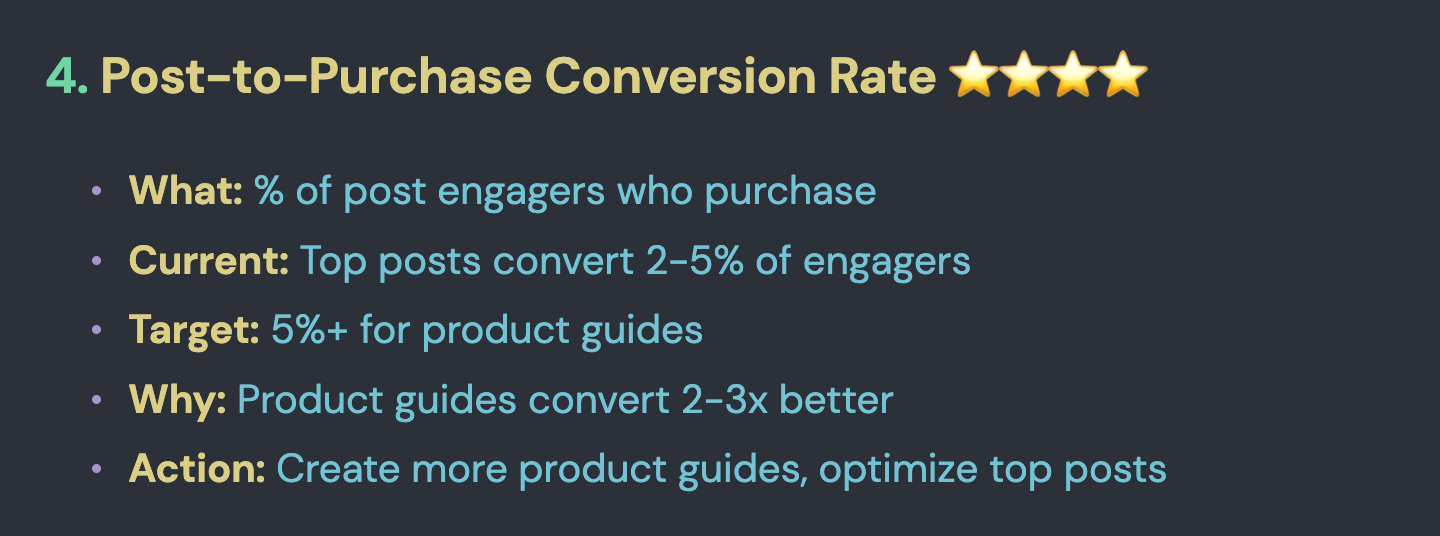
4. Post-to-Purchase Conversion
Top posts convert 2–5% of engagers
Aim for 5%+ on product guides
This is the ultimate measure of post quality.
Secondary KPIs (Helpful but not primary)
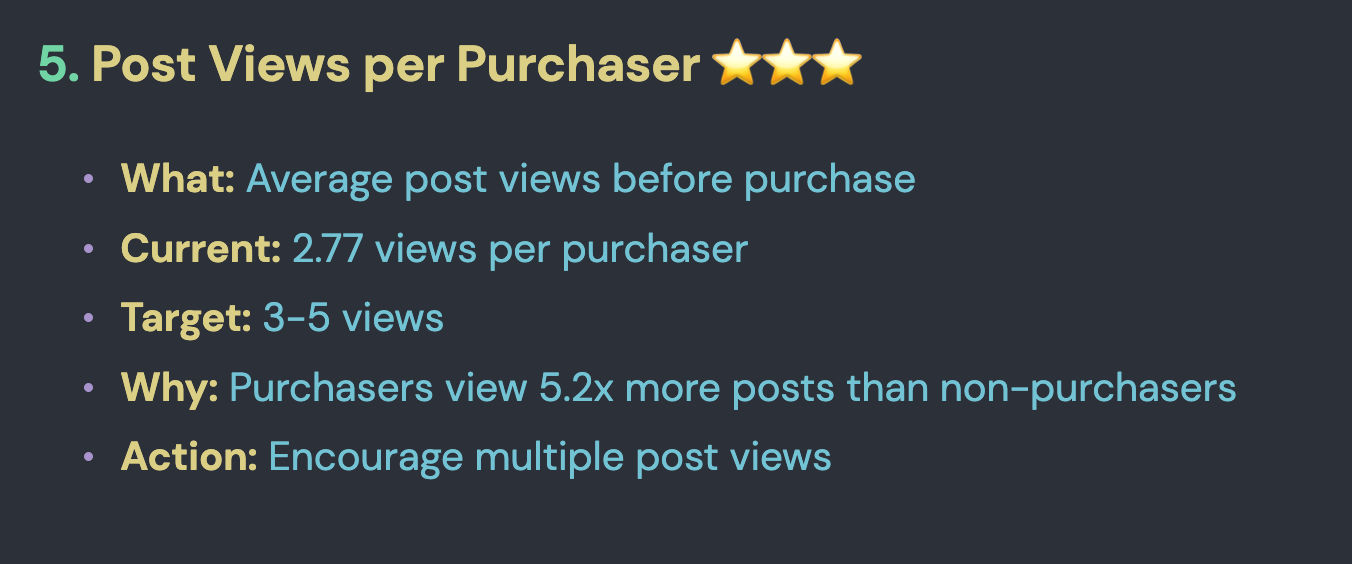
5. Post Views per Purchaser
Purchasers view 2.77 posts on average —
5.2× more than non-purchasers.
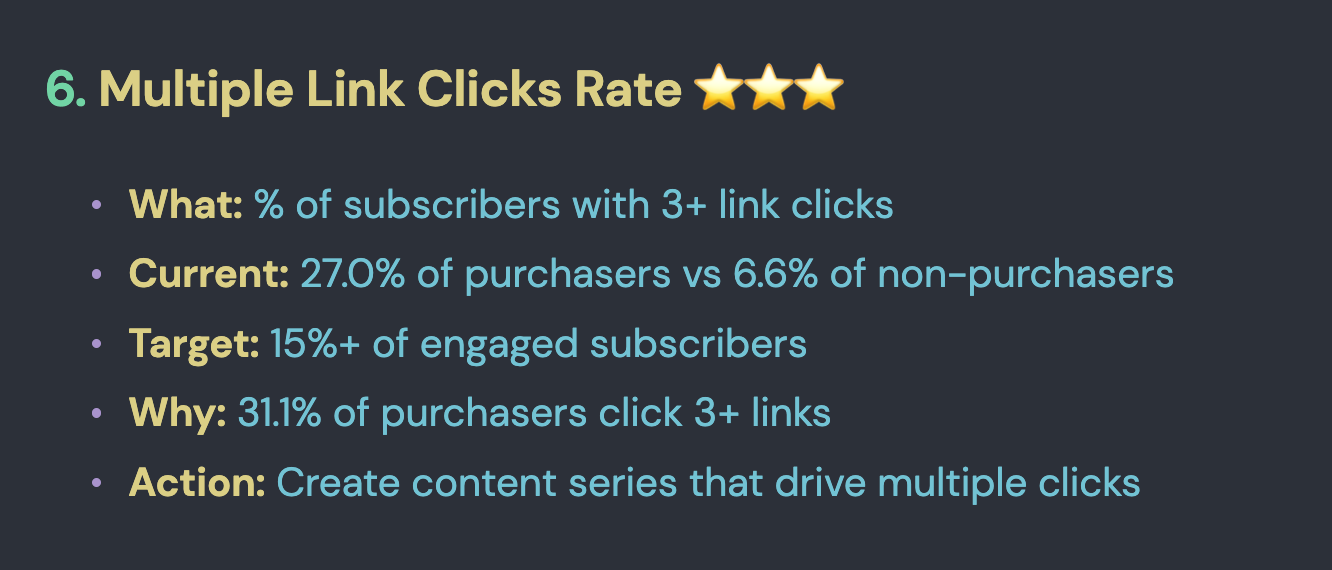
6. Multiple Clickers
27% of purchasers click 3+ links
Only 6.6% of non-purchasers do.
Metrics to Avoid Optimizing For
Email opens
Total event count
Views alone
These metrics feel important.
They’re not.
Part 5: How to Implement This for Your Newsletter
Once I saw how strongly link-click behavior predicted purchases, something simple became obvious: creators don’t need more content — they need clear behavioral signals and an easy way to act on them.
Below is a tiered path so you can pick the level that best fits your skills and available time.
Tier 1 — Beginner (10 minutes) — Do this first
Quick wins that expose intent right away:
Add UTM parameters to every Gumroad product link.
Track link click-through in Gumroad (or use any click-tracking tool).
Identify which posts have the highest click rate.
If you only do one thing this week: add UTMs + check your top 3 posts’ click rates. That single action will tell you where your revenue is hiding.
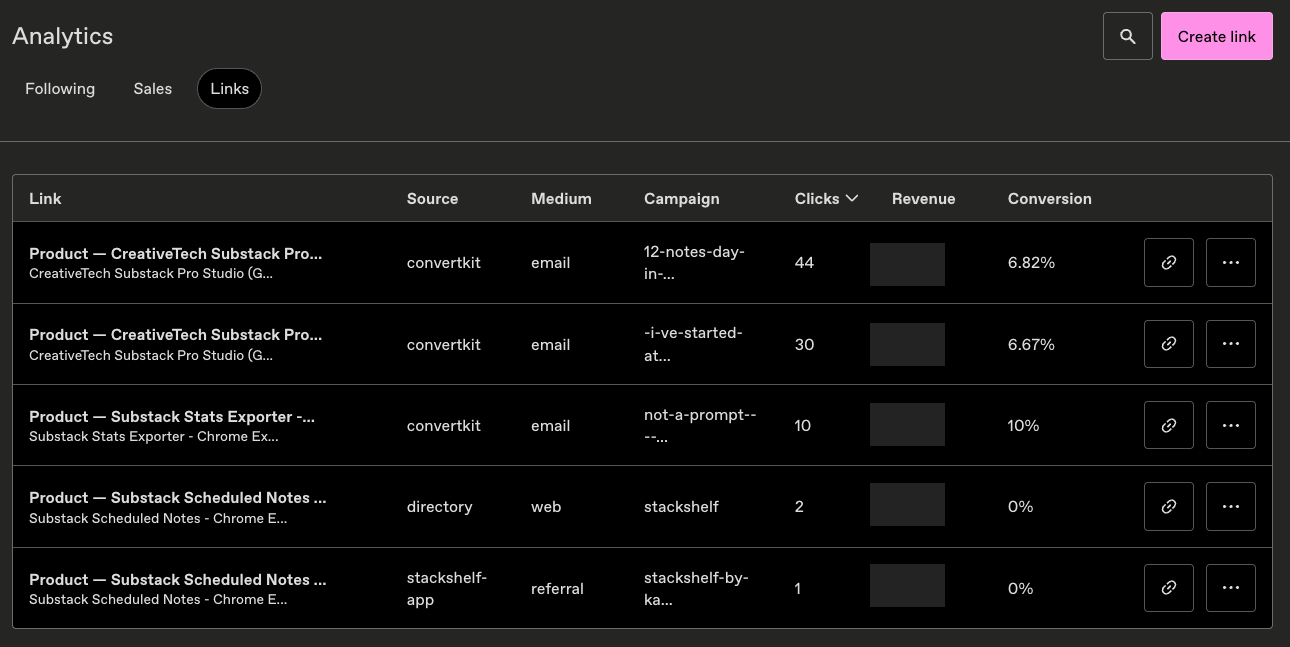
If you’ve never looked at Gumroad’s Analytics → Links page, you’ll be shocked at how informative it becomes once UTMs are in place — source, medium, campaign, click count, conversion rate, and revenue per link.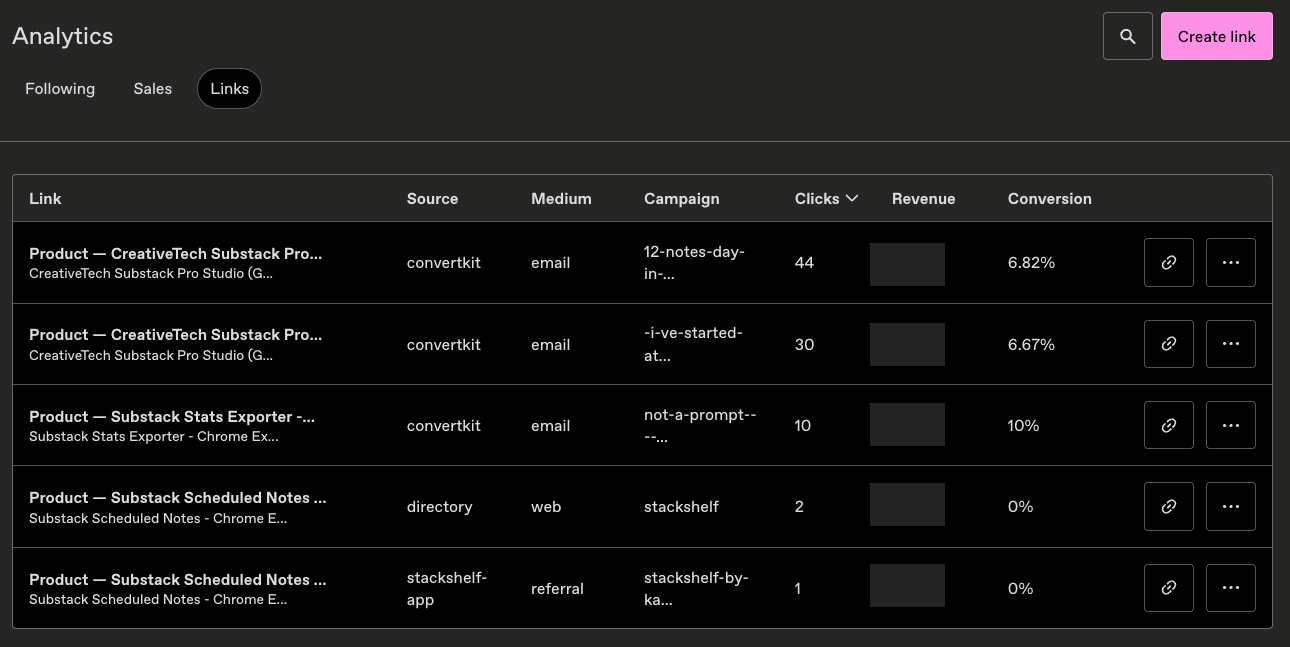
Gumroad Analytics has a Links page with UTM data
Tier 2 — Intermediate (1 hour)
Start answering the questions that matter: which posts actually lead to purchases and how fast.
Identify your top 5 converting posts.
Compare click → purchase timing for those posts.
Map simple buyer personas (fast movers, considered buyers, deep engagers).
These steps let you repeat what works.
Substack Control Center can help export this post data.
Tier 3 — Advanced (analytical creators)
Stitch behaviors together for predictive power.
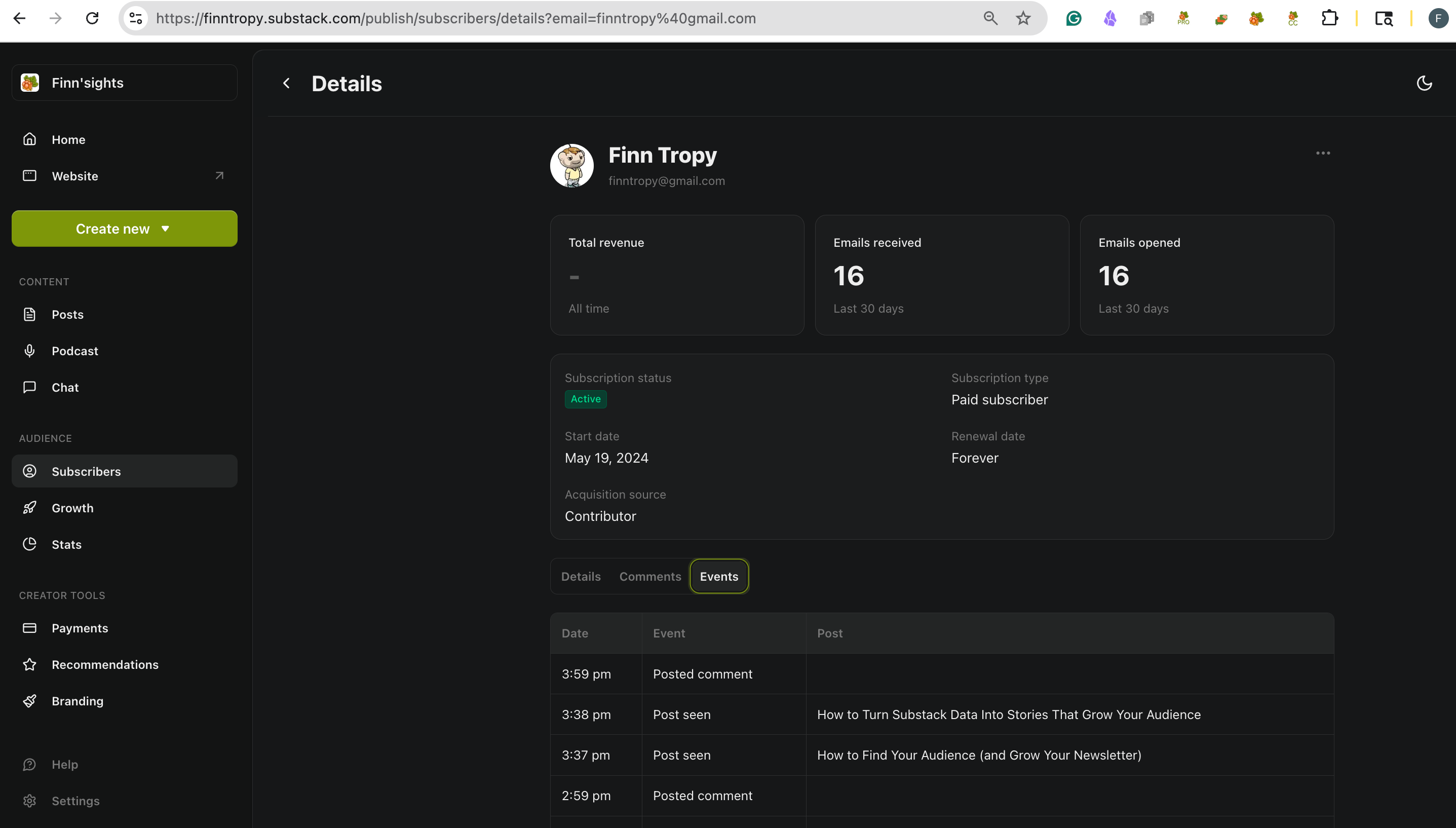
Export Substack Subscriber Events data.
Export Gumroad Sales data.
Combine Subscriber Events with Gumroad/Stripe sales data using the email address as the linkage.
Analyze event sequences and time gaps.
(Optional) Use AI to surface patterns and create segments.
This is where you’ll find the subtle timing and sequence behaviors that reliably precede purchases.
This requires a lot of Excel gymnastics if you start from scratch.
See the example screenshot for the Subscriber Events data in your Substack dashboard.
Tier 4 — Automated (if you want to skip the manual work)
Doing this manually taught me a lot of the available data fields and Substack APIs — but it’s a fiddly process.
That’s why I’m building the StackContacts tool: unified event timelines, behavioral segments, click intelligence, and early intent signals — all in one neatly organized database.
If you want to run this analysis without spreadsheets, StackContacts automates these four tiers with a single sync.
Quick wins you can apply today
Move CTAs earlier in your posts.
Publish more product guides and “how-to” walkthroughs.
Add one follow-up email sequence for readers who click product links.
These small moves compound quickly when you focus on clicks rather than vanity metrics.
Tools you can use right now
Google Sheets or a simple database (DuckDB, Postgres, SQLite)
An AI assistant (Claude, Cursor) to run queries/segment data
Gumroad’s Analytics → UTM Links for immediate click and conversion data
Part 6: The Revenue Impact
Once I started implementing these insights, everything changed.
Before Data Analysis
I was guessing
I optimized my posts for email opens and signups (free subscribers)
I had no idea what drove conversions for product sales
After Data Analysis
I understood my buyer personas
I started optimizing for link clicks
I found 40–50 link clickers/month not converting
Those 40–50 readers represent the most significant short-term revenue opportunity in my entire business.
The Potential Impact
Converting 40–50 extra link clickers =
$1,125–$2,250/monthThat’s a 25%–50% revenue increase
With the same audience size
The ROI
10 hours of setup.
2 hours/month to maintain the database
Lifetime benefit: up to 50% more revenue, less guessing
With the StackContacts tool, my design goal is to reduce setup time to 2 hours and automate database maintenance to a single “Sync” button click each month.
Conclusion: Start Tracking Right Metrics, Start Optimizing
If there’s one thing this analysis taught me, it’s this:
Creators underestimate how much revenue they’re leaving on the table
because they track the wrong things.
Key Takeaways
Link clicks predict product purchases
Speed matters — most purchases happen within 24 hours
Product guides and “How To” guides convert best
Optimize for behavior, not vanity metrics
Your Next Steps
This week: Add UTMs to Gumroad product links, and upsells on your Gumroad store's Checkout page
This month: Identify your top 5 converting posts
This quarter: Build a data-driven content strategy
The Bigger Picture
AI makes this type of analysis accessible to every creator.
You don’t need a data degree.
You need a willingness to look at the numbers.
Minor improvements in the right metrics compound quickly.
This is how you go from “hoping people buy” → predictably generating revenue.
Thanks for reading.
— Finn
Join StackContacts Beta - Only 5 Spots Open
I have a limited Alpha/Beta for creators who feel the same pain I did: conversions slipping through the cracks, and no tool that truly puts customer relationships first.
This isn’t for everyone. It’s for a small group of Substack writers who:
Use a Mac
Do not be afraid to use a command-line tool on a Mac
Are curious enough to experiment with AI tools like Claude
Are you willing to spend several hours setting up your environment to run these tools
And, most importantly, care about building deeper connections with their audience
If that sounds like you, I’d love to build StackContacts with you.
You’ll get:
Early access to the creator-first StackContacts CRM tool I’ve been testing on my own Substack
A head start in building a system that helps you remember, follow up, and stay connected as you grow your business
Ability to run deep dive analysis like in this article using AI
👉 Join the StackContacts Beta — for creators who want to stop guessing and start making data-driven decisions.
Spots are intentionally limited — I’d rather co-build with a handful of committed creators than spread myself too thin. If you’ve ever felt the pain of slipping connections, this is your chance to fix it before growth overwhelms you.
PS: Other Useful Links
If you want more consistency in posting Notes, consider checking out the Substack Pro Studio.
If you are publishing consistently, but growth still feels random, the Substack Control Center tool helps you navigate through metrics that matter.
Want to see how I set this up? (see this post)
This may be the fastest I have ever Saved a post. Amazingly detailed analysis, Finn. This confirms a few things I was suspecting, and opened my eyes to several new possibilities. Amazing work.
I gained a lot from this. I have zero paid subscribers, but people do click on the links I provide. And you're reinforcing what I've been hearing, both from my readers and from the community.
Most people want to buy once, instead of buying a paid subscription. This means I have to come up with something to sell.
I love your notes scheduler (and I was one of the buyers who researched your competitors first, lol). You put out excellent work 👏